
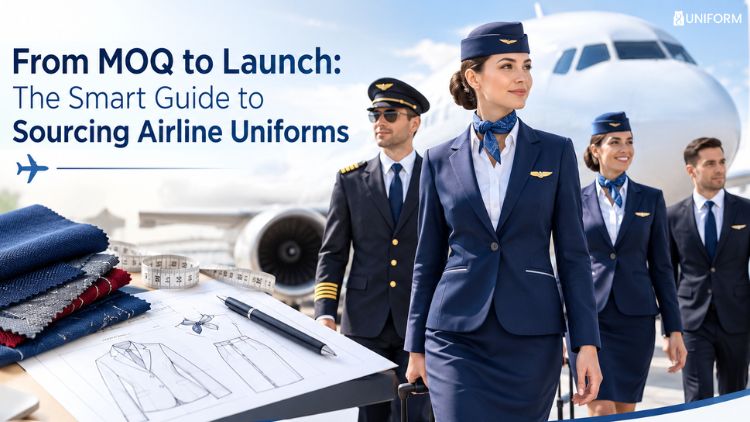
Not long back, everyone would have agreed that airline uniforms were only standard workwear. These made the crew look professional and comfortable, strengthening brand identity and contributing to the overall passenger experience. But these are now changing, little by little.
Whether it comes to airlines, uniform suppliers or aviation companies, there is a need to make several practical considerations. It is important to consider production lead times, sampling and minimum order quantities (MOQ). Here is a smart guide to sourcing airline uniforms that will definitely help you to select the right outfits for your retail or private label brand inventory.
Minimum Order Quantity (MOQ) means the smallest number of units that a manufacturer is ready to produce, for a specific order. MOQ can vary, when it comes to sourcing airline uniforms, based on:
Airline companies may need uniforms in various sizes and styles, including shirts, trousers, skirts, waistcoats and outerwear. When very small quantities are ordered, it can raise the per-unit cost. On the other hand, ordering excessive quantities can lead to storage challenges and tie up capital.
Naturally, airlines and aviation brands need to discuss MOQ requirements before designs are finalized. It can also help to determine whether the MOQ is applicable for every size, color, style or entire collection.
Even before committing to full-scale production, it is possible to assess a uniform with sampling. It is especially important for airline uniforms, as these need to be durable, make employees comfortable, help them to move easily and look highly professional.
With proper sampling, sourcing teams can easily evaluate whether the design interpretation of the manufacturer satisfies the intended specification. It helps to make changes to the trims, fit, branding, fabric or construction before initiating bulk production.
If you skip this stage, it can lead to wastage of expenses in case large quantities of airline uniforms are manufactured with incorrect specifications.
You must evaluate a uniform sample from visual as well as functional perspectives. Check the fabric for:
It is equally important to consider the fit. Make sure that the jackets, trousers, shirts, skirts and dresses allow sufficient movement, not appearing loose or poorly structured. Ensure that the shoulder width, trouser rise, pocket placement, waistband construction, sleeve length and overall proportions match the approved specifications.
It is also essential to inspect the branding elements with care. Check whether the badges, labels, printed logos, buttons, embroidery, zippers and other trims are positioned correctly and securely attached.
Wherever possible, it is necessary to identify potential issues before production. Samples must go through proper washing, durability checks and wear inspections.
It is necessary to consider the lead time – which is the amount of time that is needed for an order to move from confirmation to the eventual delivery stage. When it comes to airline companies, this can involve a number of stages. These stages include:
The exact lead time is based on various factors, such as:
More time may be required for specialized trims or custom fabrics. It is essential to not focus only on the manufacturing period. While establishing delivery deadlines, sourcing teams also need to take the entire supply chain into account.
Airline companies need to launch a new uniform collection with proper planning, backward from the rollout date. Enough time should be given for design finalization, sampling, approvals, shipping, distribution and more.
In case of large uniform programs, different apparels may need to be manufactured at the same time. With a detailed production schedule, all these stages can be coordinated. It can reduce the risk of the entire rollout being affected by a single delayed component.
It is especially useful to have buffer time when deadlines are fixed around branding changes, recruitment programs, seasonal operations or other big airline initiatives.
You can easily understand how important it is to coordinate carefully, to source airline uniforms successfully. Tie up with a top formal uniform manufacturer who can provide you with quality supplies along with low MOQ, super-quick deliveries and customization assistance. It will be much easier for you to score with your airline uniforms collection for your retail or private label brand.

August 31, 2026

July 11, 2026

June 13, 2026

March 31, 2026
March 9, 2026